Areas we cover across London
We work from our workshop at 6 Atlas Road, Wembley HA9 0JH, across Greater London and the near Hertfordshire border.
Core coverage
Where most of our work is
Being based in Wembley means north, west and central London are on our doorstep. These are the areas we are in most weeks.
- Wembley
- Harrow
- Brent
- Ealing
- Camden
- Westminster
- Kensington & Chelsea
- Hammersmith & Fulham
- Barnet
- Islington
- City of London
- Watford
Full list
Every area we survey and install in
- Wembley
- Harrow
- Brent
- Ealing
- Acton
- Willesden
- Kilburn
- Camden
- Islington
- Westminster
- Marylebone
- Fitzrovia
- Mayfair
- Kensington
- Chelsea
- Hammersmith
- Fulham
- Chiswick
- Shepherd's Bush
- Notting Hill
- Maida Vale
- St John's Wood
- Hampstead
- Highgate
- Finchley
- Barnet
- Mill Hill
- Edgware
- Stanmore
- Pinner
- Northwood
- Ruislip
- Uxbridge
- Hayes
- Southall
- Greenford
- Wood Green
- Enfield
- Walthamstow
- Hackney
- Shoreditch
- City of London
- Clerkenwell
- Southwark
- Battersea
- Wandsworth
- Richmond
- Twickenham
- Kingston
- Watford
- Bushey
- Borehamwood
Not on the list? If you are within the M25 it is worth a call. We travel for larger projects and can usually fit a survey around work already booked nearby.
What we do across these areas
- Aluminium sliding doors in London
- Sliding patio doors in London: replacing the door you already have
- Slim sliding doors: what the sightline numbers mean and when they earn their money
- Glass sliding doors: specifying the glass, not just the frame
- Choosing sliding door installers in London, and what to check before you sign
- Lift and slide doors: how the mechanism works and when you need it
- Sliding doors supply and fit, and what the scope should actually say
Why London geography decides your sliding door before the design does
A sliding door panel is an awkward, heavy, fragile, expensive object that cannot be tilted much, cannot be dropped, and cannot be made smaller once it is cut. Everything about installing one in London comes back to a single question: how does that panel get from the back of a lorry to the opening? In some streets the answer is four fitters and a set of suction pads. In others it is a crane over the roof and a borough road closure booked weeks in advance. The difference is thousands of pounds, and it is why we survey the route and not just the opening.
Rear extensions in Fulham, Putney and Wandsworth
The south west inner boroughs are where most of our sliding door work sits, because this is where the rear extension boom has been concentrated. Victorian and Edwardian terraces in Fulham, Parsons Green, Putney, Earlsfield and Wandsworth typically give us a wide flat-roofed extension across the back with a two or three panel slider facing the garden. The openings are generous, the panels are tall, and the access is frequently appalling.
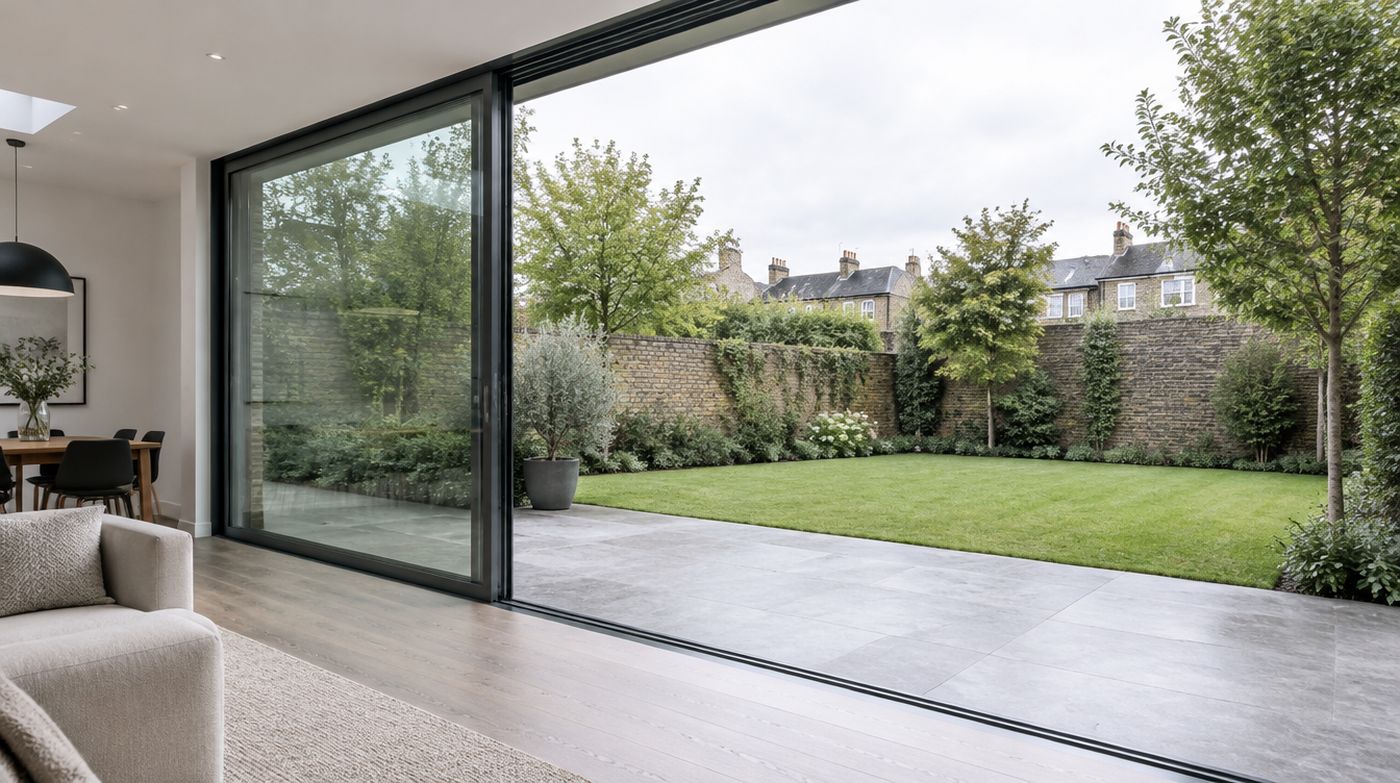
The constraint is almost always the side return. A classic London terrace has a passage down one side that is narrower than it looks once you allow for a soil pipe, a meter box, a gate post and a step. A 1.8 metre wide panel can sometimes be walked through on edge if the passage is clear and the turn at the end is wide enough. Add 200 kg and a doorway at the end of the passage and it becomes impossible. On mid-terrace properties there is no side return at all, and the only routes are through the house or over the roof. Through the house means protecting a hallway and a kitchen and getting a two and a half metre panel round a staircase newel, which is often geometrically out of the question in a narrow Victorian plan.
We check this at survey with a tape measure, not by eye, and we check the turning circle as well as the clear width. If it will not go, we tell you at survey, because the configuration can usually be adjusted. Four narrower panels instead of three wider ones changes the whole economics of a job in Putney, and it is a conversation worth having before the glass is cut rather than after.
Islington, Crouch End and the north London hill streets
North London adds slope. Islington, Barnsbury and Canonbury give us tight Georgian and Victorian terraces with vaults under the pavement and very little room at the front. Crouch End, Muswell Hill, Highgate and Dartmouth Park add gradients that matter: a street that falls steeply makes crane siting harder, makes a tracked glazing robot less stable, and means the outriggers need careful ground assessment. Many of those roads also have residents’ parking along both sides and a width that will not take a lorry and a passing car at the same time.
The housing stock in Highgate, Hampstead and parts of Crouch End also tends towards larger semi-detached and detached houses with deep gardens, which is good news for access because a side route often exists. Where it does, we can walk panels round with a glazing trolley and the job stays simple. Stoke Newington, Tufnell Park and Finsbury Park are back to terraces, and the planning gets tighter again.
Wide plots in Barnet, Harrow, Stanmore, Richmond and Dulwich
The outer boroughs are where sliding doors are easiest to install and where the biggest ones end up going. Barnet, Finchley, Mill Hill, Harrow, Stanmore, Pinner and Edgware are dominated by 1930s semi-detached and detached houses with driveways, side gates and genuine garden access. Richmond, Teddington, Twickenham, Dulwich and Blackheath offer similar plots with more varied periods. A four panel slider on a three-track system is a straightforward day’s work on a property like that, because a trolley can reach the opening and the panels never leave the ground.
The technical work shifts to the structure instead. A 1930s semi has a solid or early cavity rear wall, often with a poorly supported original opening, so the new beam and padstone design matters and the door head needs a proper deflection allowance. Those houses are also commonly extended with a shallow pitched roof over the new space, which eats soffit height. That is where the number of tracks gets decided, since each extra track costs head depth. Many of these properties face south or west across a long garden, so solar control glass is usually the right specification rather than an upsell.
Harrow, Stanmore and Edgware also have a lot of large family houses where the owners want the opening as clear as possible, and this is where pocket sliding doors make the most sense. There is usually wall length available for the pocket, which there very often is not in a Fulham return.
Riverside and new-build flats in Nine Elms, Battersea, Greenwich and Canary Wharf
Flats are a completely different operation and we price them differently. In Nine Elms, Battersea Power Station, Greenwich Peninsula, Canary Wharf, Royal Docks and the Wandsworth riverside developments, the panel is going up in a service lift or it is not going up at all. The first measurement we take is the lift car: internal length, width, height, and the diagonal, because a 2.6 metre panel will only enter a 2.1 metre high car if it can be angled and the roof hatch cannot be used.
Then come the building rules. Most managed developments require a method statement and insurance documents in advance, restrict working hours, require the goods lift to be booked for a specific window, insist on protection to lift cars and common parts, and have a concierge who will turn a delivery away at nine in the morning if the paperwork is not right. Loading bays have height restrictions that a glass lorry with a crane arm may not clear. On balconies there may be no way to get a panel out onto the terrace except through the flat, and on high floors a crane lift is usually out of the question entirely.
None of that is a reason to avoid the job. It is a reason to plan it. For internal sliding screens and room dividers in riverside flats, which is a lot of what we fit in these buildings, panel sizes can be designed around the lift from the start, and that single decision makes the installation routine instead of fraught.
Conservation areas and listed buildings
Large parts of inner London sit in conservation areas: swathes of Islington, Hackney, Camden, Kensington and Chelsea, Richmond, Dulwich and Chiswick among them. A conservation area designation mostly bites on what is visible from the street, which is why rear extension sliders are often acceptable where front elevation changes are not. That is not a guarantee, and some areas have an Article 4 direction that removes permitted development rights entirely.
Listed buildings are stricter and the conversation is different. Listed building consent is required for alterations affecting character, and that includes the rear. Slim aluminium sliding doors are sometimes accepted into a modern rear extension on a listed property precisely because they read as clearly contemporary rather than as fake historic joinery, but that is a judgement for your conservation officer and your architect, not for us. We will tell you what the glass and frame can do. We will not tell you it will be approved. If you are in Hampstead, Highgate, Spitalfields, Barnes or any of the Georgian squares, get the consent position settled before you order anything.
When the only way in is over the roof
On mid-terrace streets across Fulham, Walthamstow, Brockley, Tooting and Leyton, the panel goes over the house or it does not go. That means a crane or a spider lift, and it means a proper lifting plan: a competent appointed person, ground bearing checked, outriggers set, exclusion zones, and the right lifting accessories under LOLER. Vacuum lifters are rated for a maximum weight and a maximum glass size, which is another reason the arithmetic on panel weight has to be right rather than approximate.
The street side of it is the bit that takes time. A crane standing in a residential road normally needs a parking suspension or a temporary road closure from the borough, and boroughs want notice measured in working days, sometimes weeks rather than days. Bays have to be suspended, signage put out in advance, and neighbours warned. Scaffolding, a skip and a crane all wanting the same stretch of kerb on the same morning is a common and entirely avoidable disaster. If your project has a main contractor, this is usually theirs to arrange and we will tell them what we need. If you are running the job yourself, we will tell you exactly what to apply for and when.
Overhead services, street trees and neighbouring roof lights all affect the swing. We survey for them. A mature plane tree in a Wandsworth street has stopped more crane lifts than anything structural.
Parking, permits, ULEZ and the practical cost of a London street
These things are not glamorous but they show up in the price, and we would rather be straight about them than hide them in a line item.
- Controlled parking zones across virtually all inner boroughs mean a fitting van cannot simply park outside. A visitor permit from you, or a suspended bay arranged by us, needs sorting before the day.
- Red routes on main roads through Brixton, Camden, Finchley, Hammersmith and similar mean no loading at all outside restricted hours. That changes the start time of your installation.
- Narrow one-way streets and width restrictions determine the size of vehicle, which in turn determines how many panels arrive at once and whether an extra delivery is needed.
- ULEZ and the wider low emission zones apply across Greater London. Our vehicles are compliant, but a specialist crane or plant brought in from outside London may carry a charge, and if so it will be itemised rather than buried.
- School streets and timed closures in boroughs including Hackney, Haringey and Lambeth restrict access at the start and end of the school day.
- Estate and private road access often needs a permit from the managing agent, which is the owner’s to obtain and is best requested early.
Where we are strongest
We cover Greater London for sliding doors and we are strongest in the north, west and central boroughs, which is a function of the workshop being in Wembley. From Atlas Road we are close to Brent, Barnet, Harrow, Ealing, Camden, Islington, Westminster, Hammersmith and Fulham, Kensington and Chelsea, Richmond and Hounslow, and we work regularly across the river into Wandsworth, Lambeth, Southwark, Greenwich and Lewisham. Being close matters more than it sounds on this product, because the glass is made here. If a pane is damaged on site we can often have a replacement cut, toughened and back out to you in a fraction of the time a fabricator would quote, and that is the difference between a snag and a season of waiting with a boarded opening.
If you are outside that core and the job is a sliding door of real size, call anyway. Travel is rarely the deciding factor. Access is. Tell us the postcode, whether there is side access, and roughly how wide the opening is, and we will tell you on the phone whether this is a simple carry or a crane job before anyone comes out. 020 4634 6045, Monday to Friday, 8am to 5pm.
Get a fixed price for your sliding doors
Tell us the opening width and what is behind it. We will survey across London and quote in writing, access and making good included.