Choosing sliding door installers in London, and what to check before you sign
A sliding door is a heavy, precise, one-chance installation. This page is about judging the company that will do it, not the brochure they arrive with.
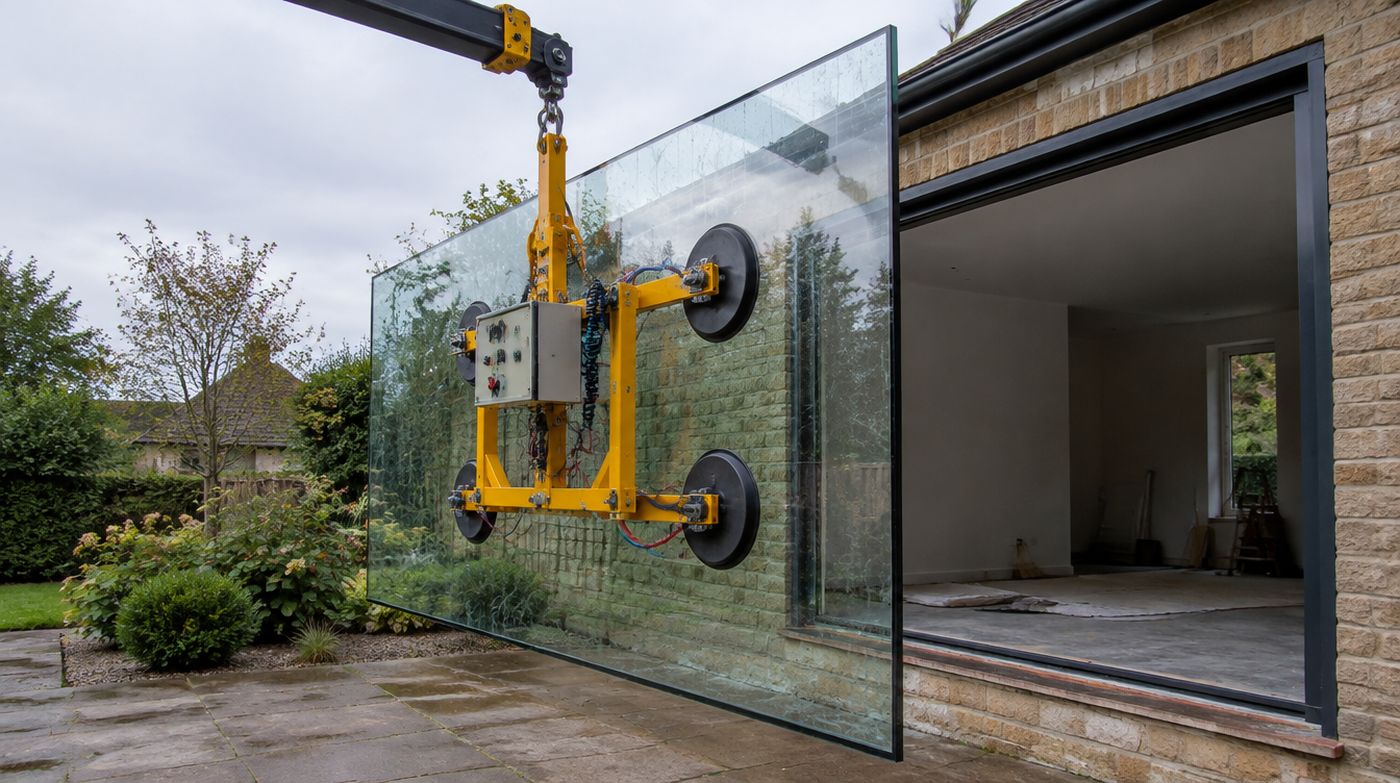
Most sliding door installers London homeowners meet first are sales staff
Book three appointments and in most cases the people who turn up will be salespeople on commission, not surveyors and not fitters. That is not automatically dishonest, but it changes how you read the meeting. The person quoting is not the person who will measure, and neither of them is the person who will stand in your garden at eight in the morning with a 200kg panel on a suction lifter.
So the first three questions for any sliding door installers London has to offer are simple. Who carries out the technical survey, and does it happen before or after I pay a deposit? Who physically installs, and are they employed by you or subcontracted? And who do I call in year four when a panel needs adjusting? If the answers are vague, the rest of the conversation is decoration.
Our own answer, so you can compare: we survey before we manufacture, we install with our own teams rather than subcontractors, and we make the glass in our own workshop in Wembley. Judge us against the same list as everyone else.
Can they actually lift your panels?
This is the question that separates companies who fit sliding doors from companies who fit windows and occasionally sell a sliding door. A single large sliding panel can weigh more than a quarter of a tonne. It cannot be walked through a house by two people holding the edges, it cannot be rested on a finished floor while someone catches their breath, and it will not forgive being dropped a centimetre onto an aluminium threshold.
Ask what equipment comes with the job and how many people are on site. The honest answers involve some of the following: vacuum suction lifters, a tracked glass manipulator for large panels, a scaffold tower, a genie lift, a crane or hiab where the glass has to go over a roof or up to a balcony, and a four or five man team on a large elevation rather than two. Ask who hires the lifting equipment and whether it is in the quoted price or added later.
Then ask the awkward one. If the panel cannot get through the house or round the side, what is the plan? The answers are a crane, a different panel configuration with smaller panels, or glazing from the outside off a scaffold. A company that has not thought about it will improvise on the day, and improvising with glass is how thresholds get damaged, plaster gets knocked out and panels get broken.
What a sliding door survey has to cover
A survey is not a measurement. It is the document that the manufacture, the method and the price all rest on. Ours takes considerably longer than people expect, and this is roughly what is being recorded.
- Structural opening width and height, measured at three points each way, with the variation noted rather than averaged away.
- Level across the threshold and plumb at both jambs, with diagonals checked for square.
- What is above the opening: lintel or beam, its condition, and the deflection the glazing system permits.
- Floor build-up inside and paving level outside, which sets the threshold height and whether a low threshold is achievable.
- Drainage: where water goes, whether a channel is needed, and the falls on the external surface.
- The access route from the kerb to the opening, measured at its narrowest point, with gates, steps, turns and ceiling heights noted.
- Parking: whether a bay suspension, a permit or a loading restriction applies, and how far the carry is.
- Services in or near the frame zone: alarm contacts, lighting, sockets, ducts, pipework.
- The agreed configuration, handing, lock position, clear opening in millimetres and glass size per panel.
- The agreed scope of making good, in writing, with exclusions named.
If a company gives you a firm price without seeing the opening, they are quoting a frame from a price list and your survey findings will arrive later as variations. A free survey before order is not a favour. It is the only basis on which a fixed price means anything.
Registration, insurance and who stands behind the guarantee
Replacement doors in an existing dwelling are notifiable work under the building regulations. The straightforward route is an installer registered with a competent person scheme such as FENSA, who self-certifies the work and issues a certificate. We are FENSA registered, and that certificate is the piece of paper a buyer’s solicitor will ask for when you sell. If the doors are going into a new extension instead, the work is covered by the building control application for the extension and there is no FENSA certificate to expect. Anyone promising you one on an extension has not understood the question.
Separately, ask about insurance. Public liability cover for work on your property, and employers’ liability if the company has employees on your site. Ask for the certificate, not a reassurance.
Then ask what the guarantee actually is and who pays for it. There are usually three separate guarantees on a sliding door: the system manufacturer on the frame and finish, the glass processor on the sealed units, and the installer on the installation. They have different lengths. An insurance-backed guarantee transfers to an insurer if the company stops trading, and is worth asking about specifically.
A twenty year guarantee from a company with no workshop, no employees and a trading history shorter than the guarantee is worth less than a five year guarantee from an installer who will still be reachable. Ask how long they have traded, where they work from, and whether anyone there can service the system they are selling you.
Access assessment: the part most quotes skip
London makes this the deciding factor on a surprising number of jobs, and it is where a quote given over the phone falls apart.
Victorian and Edwardian terraces in the inner boroughs frequently have no side access at all, which means panels come through the house, over your floor and round a staircase, or they go over the roof on a crane. Mansion blocks have goods lifts with internal dimensions that decide your maximum panel size for you, plus building management who want notice, insurance details and sometimes restricted working hours. Basement flats mean carrying down. Roof terraces mean lifting up, and lifting over a parapet needs planning rather than enthusiasm.
Then there is the street. A large delivery needs somewhere to stand, and in much of inner London that means suspending a parking bay through the borough, with several working days’ notice and a fee. Red routes, controlled parking zones, narrow one-way streets and low traffic neighbourhood restrictions all affect how the glass arrives. If nobody asked how the glass gets from the road to the opening, they have not priced your installation, and the cost of finding out on the day lands somewhere. It is the part of the job that sliding door installers London wide most often leave until the morning.
Warning signs in a sliding door quote
A price given before anyone has seen the opening. A discount that expires at the end of the visit. A quotation with no system name or series, so you cannot look up the data yourself. Glass described only as double glazed, with no thicknesses, coatings or unit make-up.
No clear opening dimension and no glass size per panel, which means you cannot compare two quotes on what you actually get. No whole-door U-value at your size. Craneage or lifting listed as if required, which is a way of pricing a job without assessing it. No lead time. No making good scope. A deposit demand of most of the contract value. A cash price with no VAT shown. And subcontracted fitters described in the passive voice.
None of these alone proves anything. Three of them together tells you what kind of company you are dealing with.
Deposits, staged payments and what is reasonable
Made-to-measure aluminium is manufactured for your opening and cannot be resold, so a deposit is normal and expected. What is not normal is paying most of the money before anything is made, and it is certainly not normal to pay in full before installation.
A sensible structure is a deposit on order that reflects materials, and the balance on completion once the doors are installed, operating, sealed and demonstrated to you. Pay the deposit by card or bank transfer so there is a record, be wary of pressure to pay cash, and get the staging written on the order rather than agreed verbally. Hold back the final payment until you have operated every panel, checked that each one locks without being lifted or shouldered, and received the certificate and guarantee paperwork.
The questions worth asking, and the answers you want
Who surveys, and when? Before manufacture, by someone technical. Are your fitters employed? Employed, or a long-standing team you can name. What system is this, and what series? A specific answer with published data. What is the whole-door U-value at my size? A figure, not a glass figure. What is the panel weight, and what is the hardware rated for? Two numbers that leave sensible margin.
How will the panels get in? A method, naming equipment. Who is responsible if the opening is the wrong size? Whoever measured, and it should be them. What exactly is making good? A list. What certificate do I get? FENSA on a replacement, building control on an extension. And who services this in five years? A named company with a workshop.
Most sliding door installers London homeowners shortlist will manage six or seven of those. Any firm that answers all nine without hesitation is a serious installer. We would rather you asked us those questions than took our word for it, because the companies that lose work to vague answers are the ones we are competing with.
FAQ
Questions about sliding door installers london
Do sliding door installers need to be FENSA registered?
Not legally, but the work on a replacement door in an existing home is notifiable under the building regulations, so it has to be certified somehow. A registered installer under a competent person scheme such as FENSA self-certifies and issues a certificate you will need when you sell. The alternative is for you to make a building control application and pay the council directly, which costs more and takes longer. If the doors are part of a new extension, the extension’s own building control covers them and no FENSA certificate applies. An unregistered installer on a replacement leaves you to deal with that yourself.
How many people does it take to install sliding doors?
It depends on panel weight and access, which is exactly why it should be assessed before you are given a price. A modest two panel replacement with good access is a two or three man job. Large panels, which commonly weigh between 150 and 300kg each, need four or more people plus mechanical lifting: vacuum suction lifters, a tracked glass manipulator, a scaffold tower, or a crane where the glass has to go over a roof or onto a balcony. If a company plans to install a large elevation with two fitters and no lifting equipment, ask how, and get the answer before you order.
Should I pay a deposit for sliding doors?
Yes, a deposit is normal. The doors are manufactured to your survey dimensions and cannot be resold, so suppliers reasonably want cover for materials before they order frames and glass. What is not reasonable is paying most or all of the price up front. Expect a deposit on order and the balance on completion, written into the order rather than agreed on the doorstep. Pay by a traceable method, and keep the final payment until the doors are installed, every panel operates and locks properly, the perimeter is sealed and you have the guarantee and certification paperwork in hand.
Get a fixed price for your sliding doors
Tell us the opening width and what is behind it. We will survey across London and quote in writing, access and making good included.