Lift and slide doors: how the mechanism works and when you need it
The handle on a lift and slide door does something mechanical before the panel moves. Understanding what, and why, tells you whether you need the gear or are being sold it.
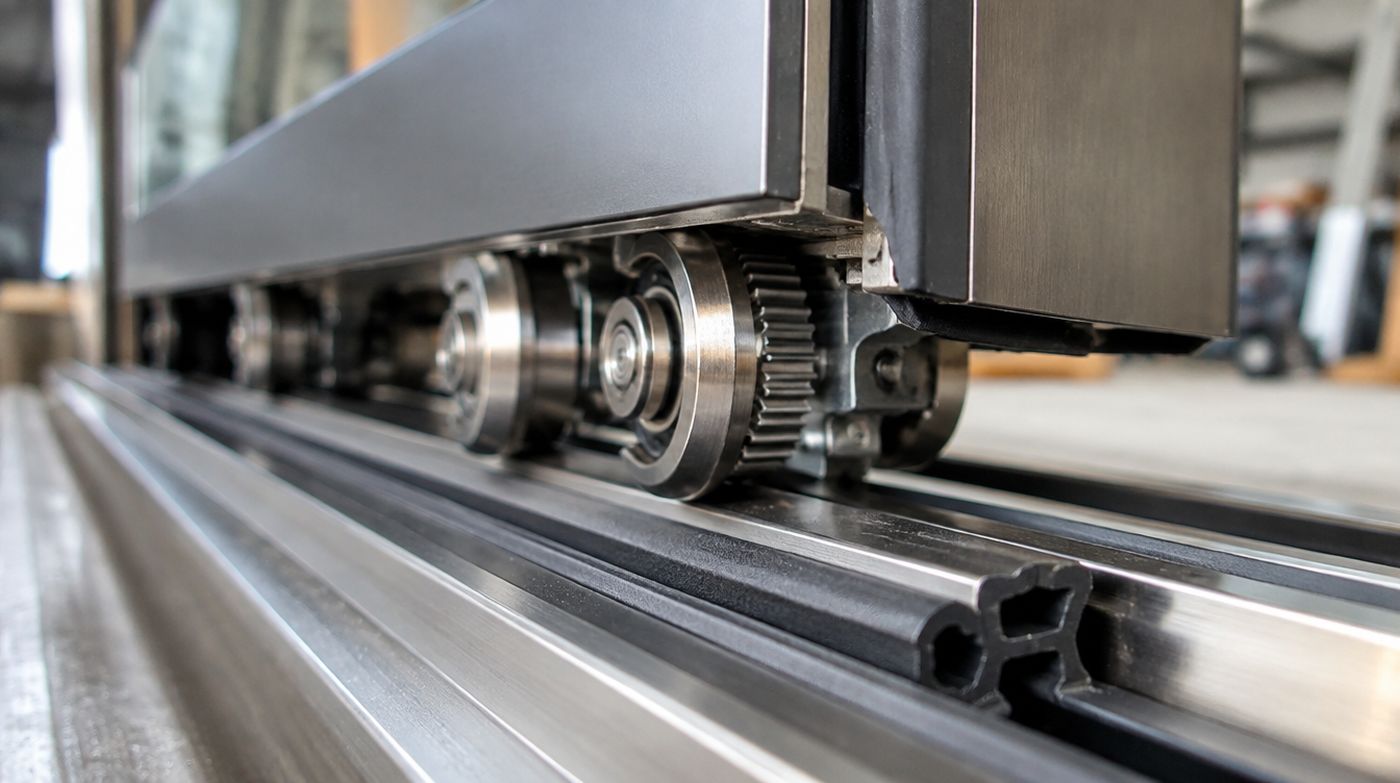
Lift and slide doors: what the handle is actually doing
On lift and slide doors the handle is not a latch, it is a lever on a gearbox. Turn it, usually through most of a half circle, and a gearbox inside the sliding panel drives rods up and down the stile to a lifting mechanism at the bottom of the leaf. That mechanism raises the whole panel a few millimetres, off its seals and onto its running wheels. Only then does the panel slide. Turn the handle back and the panel lowers, settling down onto compression seals and into its locking points.
Compare that with a conventional inline sliding door, where the panel sits permanently on rollers and brush seals wipe against the frame as it moves. The mechanical difference is the whole story: a lift and slide panel is only on wheels while you are moving it, and spends the rest of its life clamped down on gaskets. Which of the two suits your door is argued on our aluminium sliding doors page. What follows here is the mechanism itself.
Inside the running gear
A lift and slide panel runs on carriages, not loose wheels. Each carriage holds two or more wheels on sealed bearings, bolted into the bottom rail of the leaf, and each carriage has a published load rating. The number of carriages per panel is chosen from the panel weight, which is why panel weight has to be calculated before hardware is ordered rather than after.
The wheels run on a track, which on a decent system is a stainless steel capping set into the aluminium threshold rather than bare aluminium. Stainless matters because aluminium is soft and grit under a steel wheel will groove a bare aluminium track within a few years, after which the panel never runs sweetly again.
At the head, the panel is held in line by guides rather than carried, so the head carries no weight and its job is to stop the top of the leaf from wandering. The lifting mechanism itself is usually a cam or wedge arrangement driven by the operating rod, mechanically simple, with very little to go wrong provided it is adjusted correctly and nobody forces the handle while the door is locked.
The weights and sizes where lift and slide stops being optional
Hardware is rated by panel weight, in bands. Standard inline roller gear on good systems works up to the low hundreds of kilograms per panel. Lift and slide gear sets run considerably higher, into several hundred kilograms, with heavy-duty sets higher still. The trigger for moving up is normally weight, occasionally panel width.
Here is the point at which the decision usually makes itself. Take a panel 1.8 metres wide and 2.8 metres tall in a triple build-up with a laminated inner pane, something like 24 or 25mm of actual glass in total. That pane alone carries over 300kg before you add a single gram of aluminium. That is beyond inline roller gear on most systems and squarely in lift and slide territory.
Width matters separately. On a very wide panel, the force you apply at a handle near one edge has a long way to act, and an inline leaf resting its whole weight on rollers will tend to twist and bind. A lift and slide panel, lifted clear and running on carriages, handles that far better.
So ask for two numbers side by side on your quotation: the calculated panel weight, and the rated capacity of the gear being supplied. If the panel is comfortably inside standard inline capacity and the elevation is sheltered, lift and slide is a preference rather than a requirement, and should be priced as an upgrade you can decline.
Why lift and slide doors seal better when they are shut
This is the performance argument, and it is the strongest one. Because the panel lowers onto its seals, you get compression rather than a wipe. A brush or fin seal on a conventional slider has to be loose enough for the panel to move past it continuously, which caps how hard it can press. A lift and slide gasket is squeezed by the weight of the panel itself and by the locking points pulling it in.
In practical terms that shows up in the tested classifications for air permeability, watertightness and resistance to wind load, measured under the relevant European test standards and expressed as classes. Lift and slide versions of a system routinely post better classes than the inline versions of the same system. On an exposed elevation, a west-facing wall of glass taking driven rain, or a roadside door where noise comes in on the air path rather than through the glass, that compression seal is doing more for you than another millimetre of laminate.
It also protects the seals themselves. A gasket that is only rubbed when the door is actually moving lasts longer than one dragged across aluminium every time somebody opens the door.
What lift and slide doors are like to use every day
Here is the honest account, because showrooms demonstrate these doors on a perfectly level cill with nothing in the room.
The action is deliberate and two-handed. You turn the handle, feel the panel lift, then push. A heavy panel needs a firm initial push to overcome inertia and then a hand to slow it down, because 300kg moving smoothly does not stop by itself. Nothing about this is difficult, but it is not the casual nudge of a patio door, and it is worth having an elderly relative or a child try the handle in a showroom before you commit. If someone in the house would struggle with a stiff half turn, say so at specification stage: there are powered and assisted options, and there are also lighter configurations with more panels.
The good news is that the panel parks exactly where you leave it. There is no drift on a slight slope, no slamming in a gust, and no need for a stay or a catch. You also cannot leave it ajar on a latch the way you might with other doors, which is either a security benefit or a mild annoyance depending on your habits. And do not leave a panel in the lifted position for long periods: lifted means the full weight is on the carriages with the seals disengaged, which is neither weathertight nor what the gear is for.
Thresholds, drainage and the lifting action
The threshold on a lift and slide door is doing three jobs at once. It is the running surface, it is the seal face the panel drops onto, and it is a drainage channel that has to get water out of the system before it finds the inside of your house.
The lifting action adds a constraint. The panel needs clearance beneath it when raised, so the relationship between your internal floor build-up, the threshold section and the external paving level has to be set at survey rather than assumed. Where a low threshold is required, there is less upstand available to hold water back, so the external drainage has to do more: a channel drain across the opening, correct falls away from the house, and somewhere for that water to go. Guidance for accessible thresholds in new dwellings under Approved Document M keeps upstands low, which makes the drainage detail the part to get right rather than the part to leave to the paving contractor.
Maintenance and adjustment on the mechanism
Mechanically these doors are serviceable, and that is their virtue. The carriages adjust, usually on a screw accessible from the face or the bottom of the leaf, which is how a panel that has started to catch on the threshold gets put right. The operating rods have an engagement setting that can slip if a handle has been forced. Seals take a set over years and can be replaced. The lifting cams and the track take a light lubricant of the type the manufacturer specifies, not a general purpose oil that collects grit.
Two things about this are worth saying plainly. Adjustment is a service visit, not a weekend job, because a wrongly adjusted carriage on a 300kg panel transfers load unevenly and wears the gear. And it only stays serviceable if the system is a named series from a manufacturer whose parts you can still buy. Routine track cleaning we cover on the aluminium sliding doors page, but parts availability is specific to the gear, and on an unbranded import a worn carriage in year seven can mean the door becomes unrepairable.
When you should refuse to pay for lift and slide doors
On a two panel door with a double glazed unit and panels well inside standard roller capacity, on a sheltered elevation, lift and slide is an upgrade you can decline without regret. Good inline gear on a well installed door with properly compressed seals will perform perfectly well, and the money is better spent on the glass specification or the threshold detail.
Also decline it where the handle action genuinely does not suit who will use the door, and where a company has proposed it without producing the panel weight calculation that justifies it. If the quote says lift and slide but cannot say what the panel weighs, you are buying a word. Ask for the weight, the gear rating and the test classifications, and let those three decide.
What goes wrong, and what it takes to put right
The common faults are all adjustment or installation faults rather than design faults. A panel catching on the threshold as it lowers, which is usually a carriage dropped or a frame fitted marginally out of level. A handle that will not complete its turn, which is often someone having tried to slide the door while locked and pushed the rods out of adjustment. A panel that seals at one jamb and not the other, which is squareness. A grooved track where the capping is bare aluminium rather than stainless, or where grit has been left to grind. Seals compressed flat after many years of service, which is a replacement part and an hour’s work.
All of those are fixable on a proper system by someone who knows the gear. None of them are fixable on a door whose manufacturer cannot be identified. That is the real argument for buying lift and slide doors from a named system through an installer who services what they sell.
FAQ
Questions about lift and slide doors
Are lift and slide doors hard to open?
They are heavier and more deliberate than a standard patio door, not hard. You turn the handle through roughly a half circle, which takes a definite effort because it is driving a mechanism, and that raises the panel onto its wheels. Once lifted, even a very heavy panel rolls smoothly, though a large one needs a firm push to start and a hand to slow it down. The handle action is the part to test rather than the sliding. If anyone in the house has limited grip or strength, try one in a showroom first and ask about assisted or powered options, or a configuration with more and lighter panels.
How much weight can lift and slide gear carry?
It depends on the system and the number of carriages, and manufacturers publish it in bands. As a rule of thumb, good inline roller gear handles up to the low hundreds of kilograms per panel, while lift and slide sets go considerably higher, with heavy-duty versions higher again. The figure that matters is yours: the calculated weight of your panel, glass plus frame, against the rated capacity of the gear being supplied. Ask for both numbers on the quotation. A panel sized close to the limit of its hardware will wear faster and run less sweetly than one with sensible margin.
Do lift and slide doors need servicing?
They benefit from it, and they are built to be serviced. The carriages are adjustable, the operating rods have an engagement setting, the seals are replaceable and the track and lifting cams want the lubricant the manufacturer specifies rather than whatever is in the shed. A check every couple of years keeps a heavy panel running on correctly loaded carriages, which is what makes the gear last. Adjustment is not a DIY job on a panel of this weight, because a wrongly set carriage loads the gear unevenly. Before you buy, confirm the system is a named series with parts available in the UK, and ask who will service it.
Get a fixed price for your sliding doors
Tell us the opening width and what is behind it. We will survey across London and quote in writing, access and making good included.